Contact us for
 0
0
SHOPPING CART
SGD 0.00
 133 New Bridge Road, Chinatown Point #10-03 Singapore 059413
  +65 9061 2851 (Whatsapp) 24 Hrs
  contact@aceglobalaccountants.com


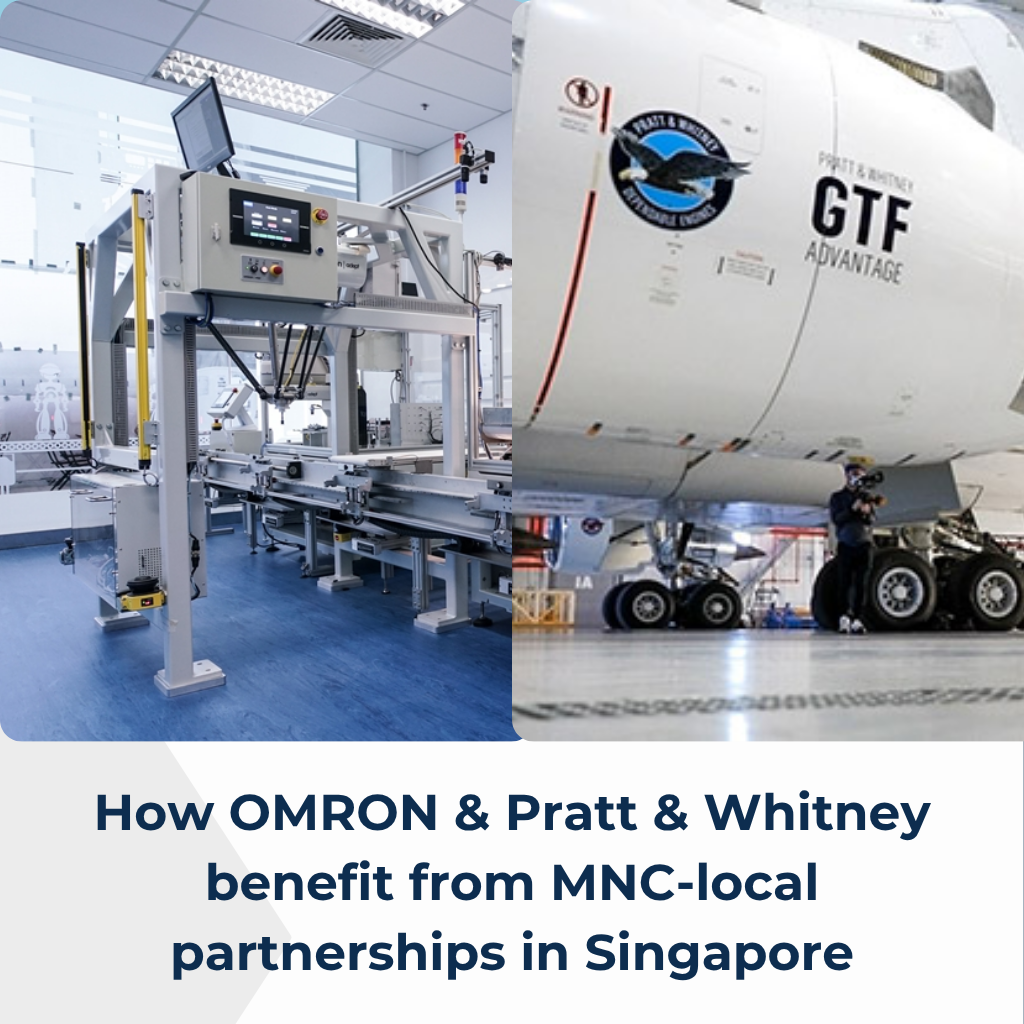
When most people think about manufacturing partnerships in Asia, Singapore doesn’t jump to mind first. They think cheap labor. They think massive factories. They think somewhere else. This is simply not entierely true.
Because what’s quietly happening in Singapore right now is something far more powerful than cheap production.
It’s a model where global manufacturing giants, companies like OMRON and Pratt & Whitney, are teaming up with nimble local enterprises to do something most multinationals struggle to do on their own: Innovate faster. Scale smarter. Compete harder.
Before we get into the case studies, let’s address the obvious question.
Why would a global aerospace engine manufacturer or a Japanese electronics giant choose Singapore as the place to build new capabilities?
Three reasons, and they’re not what you expect.
Singapore sits at the crossroads of global trade. It connects businesses to Asian markets with speed and reliability that’s hard to match anywhere else in the region.
When you’re running a global supply chain, that kind of seamless connectivity isn’t a nice-to-have. It’s a competitive weapon.
Second: Talent
Singapore’s Institutes of Higher Learning, including Nanyang Technological University (NTU) and the National University of Singapore (NUS), aren’t just producing graduates.
They’re running joint R&D programmes specifically designed to solve real-world industrial problems. The talent pipeline is built for industry, not just academia.
Third: Scale of enterprise
Singapore is home to over 600,000 enterprises, from global multinationals to local startups. That’s an enormous ecosystem of potential partners, suppliers, and co-innovators packed into one of the world’s most business-friendly environments.
At the Industrial Transformation Asia-Pacific 2025 (ITAP) conference, Minister of State for Trade and Industry Alvin Tan put it simply: Singapore can play “a unique role as a trusted connector where multinationals and local enterprises come together to co-create, build capacity, and drive innovation.”
Here’s the situation Pratt & Whitney faced.
As one of the world’s leading aircraft engine manufacturers, they needed high-performance electroplating for aerospace maintenance and repair.
This is a precision process: applying an ultra-thin metal layer to aircraft components to protect them from corrosion and wear. Get it wrong and you’re not just losing time. You’re grounding aircraft.
The traditional solution? Source overseas. Wait. Depend on a supplier on the other side of the world and manage the time zone, logistics, and trust issues that come with it.
Pratt & Whitney chose a different path.
They partnered with Applied Total Control Treatments (ATCT), a Singapore-based enterprise, to develop and localise this critical electroplating capability on the island.
The outcome was transformative.
Turnaround times dropped. Dependence on overseas suppliers decreased. And for the first time, Pratt & Whitney had a local partner capable of meeting global aerospace standards — right in their backyard.
But the numbers only tell part of the story.
General Manager Pang Yong Kiang explained what made the partnership work: ATCT’s agility, their commitment, and critically being in the same time zone.
As he put it, being in the same time zone makes “a world of difference.” Having that local capability on-island changed what was possible for their customers.
And crucially, Pang was clear that this wasn’t a traditional vendor relationship. “When we source for local enterprises to collaborate, it’s not just sourcing; it’s not a vendor-customer relationship. We are co-developing that particular repair with them.”
That framing matters. It’s the difference between a transaction and a transformation.
For ATCT, the partnership was equally significant. Chief Technology Officer Cabal Lo described it as “a turning point” for the company — one that allowed them to meet global aerospace standards through consistency, quality, and compliance with international requirements. A local company levelled up to compete on the world stage.
That’s a win-win. And it didn’t happen by accident.
Now let’s talk about healthcare.
OMRON Electronics — the Japanese automation and healthcare technology giant — wanted to develop a stroke kinetic therapy system. The concept was ambitious: combine motion tracking, adaptive therapy, and real-time feedback to personalise stroke recovery for patients.
The challenge? OMRON had the automation muscle. But they needed deep domain expertise in motion tracking and AI to make the product work in a clinical setting.
Enter Clemvision.
Clemvision is a Singapore-based automation solutions company with strong AI capabilities and experience in motion-tracking technology.
When OMRON partnered with them, something interesting happened: the combination of OMRON’s automation strengths and Clemvision’s AI innovation created a product that neither could have built alone.
Don Teng, Group Managing Director at OMRON Electronics, explained the logic clearly. “The reason we partner with them is because of their agility, their critical insights, and their deep domain expertise. By combining their motion-tracking capabilities with OMRON’s automation strengths, we realised that we could develop a solution to personalise stroke recovery.”
This is the new model of innovation. It’s not about one company having all the answers. It’s about combining complementary strengths faster than the competition can respond.
For Clemvision, the impact was equally dramatic. Founder and Director Chua Ren Tsong described how OMRON gave them the platform to apply their AI innovation to the med-tech sector — providing engineering support, clinical access, and the scale to grow with the right global partner.
A local startup got its breakthrough. A global company got its innovation edge. And patients get better stroke recovery tools.
These partnerships didn’t happen because two companies bumped into each other at a conference.
They happened because Singapore built a deliberate infrastructure to make them happen. Here’s how it works.
The MNC-LE Alliance is a structured matchmaking platform launched by the Singapore Manufacturing Federation (SMF) and supported by the Economic Development Board (EDB) and Enterprise Singapore.
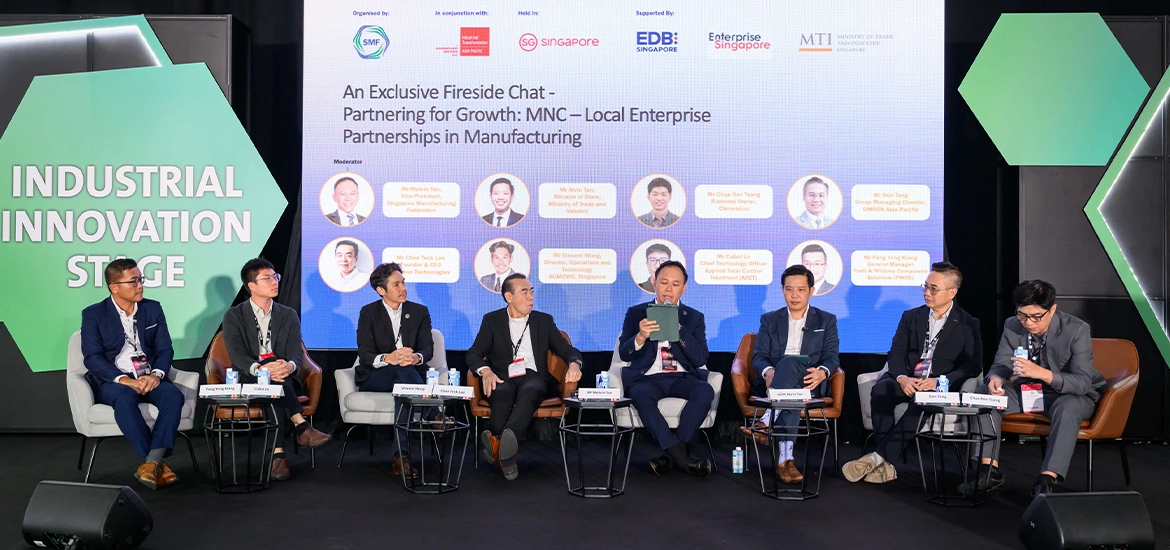
MNC-SME collaborations at the Industrial Transformation Asia-Pacific 2025 (Source: EDB Singapore)
MNCs define specific technology gaps or supply chain challenges. SMF then actively connects those problem statements with vetted, capable local SMEs. Partnerships are structured around three models: supplier development, technology transfer, or joint innovation — depending on what the collaboration actually needs to achieve.
The process is designed for real outcomes, not just introductions.
Underneath that sits a powerful funding mechanism: the Partnerships for Capability Transformation (PACT) scheme. Launched in 2010 and progressively enhanced, PACT helps MNCs and SMEs localise solutions, strengthen supply chain resilience, and co-innovate for growth across Asia. More than 2,500 Singapore-based firms have already benefited.
PACT covers costs that would otherwise kill early-stage partnerships — things like validating supplier procedures against OEM requirements, supporting SME adoption of niche technologies, funding joint product development, and providing wage support for managers overseeing supplier development.
In other words, Singapore doesn’t just make introductions. It removes the financial friction that stops partnerships from getting off the ground.
EDB and EnterpriseSG also encourage companies to start small, through pilot projects that let both parties test compatibility and build trust before committing to deeper, longer-term work.
Industry associations like SMF act as the connective tissue, feeding ground-level insights back to government so support stays relevant and responsive.
The global manufacturing environment has never been more complex.
Supply chains are under pressure. Geopolitical shifts are forcing companies to diversify production. Time-to-market is compressing. And the pace of technological change — in AI, automation, advanced materials — is accelerating faster than most large companies can absorb internally.
The companies winning in this environment aren’t the ones trying to do everything themselves. They’re the ones who’ve figured out how to combine the reach and resources of a multinational with the speed and specialisation of a local enterprise.
Singapore has engineered an environment where that combination happens faster, more reliably, and with more government support than almost anywhere else.
The Pratt & Whitney and OMRON stories aren’t one-off successes. They’re proof points for a repeatable model.
And the infrastructure supporting them. The MNC-LE Alliance, PACT, the SEZ twinning opportunities in the Johor-Singapore Special Economic Zone and the Batam, Bintan, Karimun region mean the conditions for these partnerships are only getting stronger.
Singapore’s value proposition for manufacturers isn’t just about location or tax incentives. It’s about what becomes possible when you plug into an ecosystem specifically designed to accelerate innovation through partnership.
Pratt & Whitney shortened turnaround times and built local aerospace capability. OMRON broke into med-tech with an AI-powered stroke recovery system. ATCT and Clemvision went from local enterprises to global-standard partners.
These outcomes were built deliberately by combining the right companies, the right support structures, and the right government backing.
If you’re running a manufacturing operation and you’re not looking at Singapore as a place to build your next capability or find your next innovation partner, you’re leaving a real competitive advantage on the table.
The smartest manufacturers in the world already know it. The question is whether you’ll be next.
If your company needs help filing taxes for the year 2026 or requires assistance with Singapore incorporation, economy, banking, etc., feel free to call /WhatsApp us at +65 90612851 or email us at aceglobalacct@gmail.com. Alternatively, you may leave us a reply using our contact form below.
Keep in touch to receive the latest listing, news updates and special offers delivered directly to your inbox.