Contact us for
 0
0
SHOPPING CART
SGD 0.00
 133 New Bridge Road, Chinatown Point #10-03 Singapore 059413
  +65 9061 2851 (Whatsapp) 24 Hrs
  contact@aceglobalaccountants.com


The global trade environment is not ideal: Tariffs. Disruptions. Geopolitical uncertainty.
Businesses that relied on lean, single-location supply chains are paying the price.
But a handful of companies, DHL, UPS, and Kuehne+Nagel, have quietly been building something different. Something more resilient.
Their secret? A dual-location model straddling Singapore and Malaysia’s Johor-Singapore Special Economic Zone (JS-SEZ).
In this guide, you’ll learn exactly how they’re doing it , and how your business can replicate the same strategy.
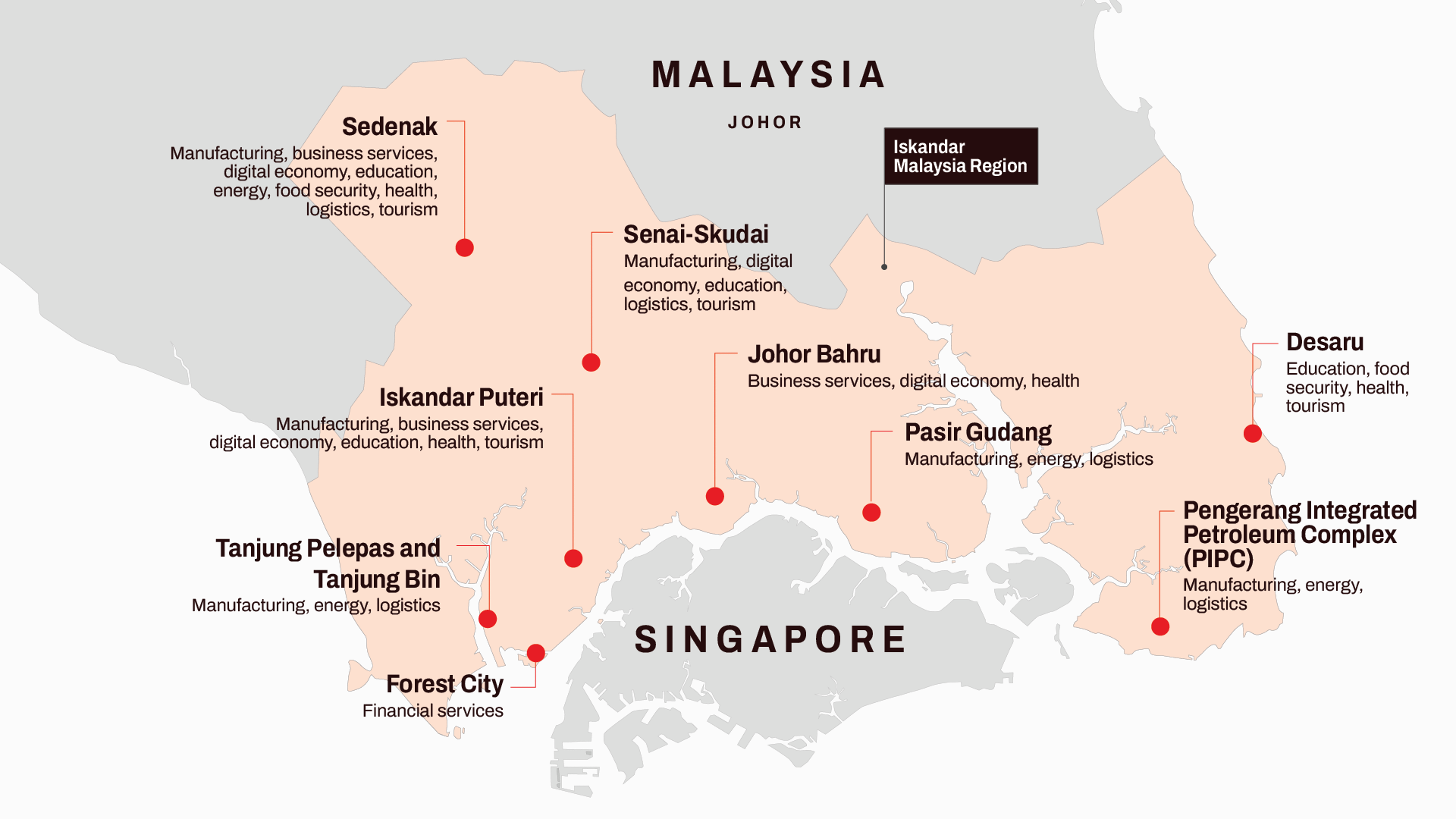
The Johor-Singapore Special Economic Zone is a cross-border economic corridor jointly developed by Singapore and Malaysia.
The idea is simple but powerful:Combine Singapore’s world-class infrastructure, global connectivity, and business credibility with Johor’s lower costs, abundant land, and competitive labour force.
The result is a supply chain model that’s both globally connected and cost-efficient. And in today’s trade environment, that combination is increasingly rare.
The most sophisticated logistics companies aren’t just operating in the JS-SEZ. They’re building what Edwin Wong, CEO of DHL Supply Chain Southeast Asia, calls “twinned” operations: Running complementary activities across both locations simultaneously.
Here how it works in practice.
Singapore handles what it does best: high-value cargo, time-critical shipments, value-added services, and global distribution. With over 7,200 weekly flights out of Changi Airport, nearly one every 80 seconds, Singapore gives businesses access to every major city in Asia within seven hours.
Johor handles everything else: large-scale fulfilment for slower-moving goods, bulk warehousing, and cost-sensitive operations. Land is cheaper. Labour is more affordable. Energy costs are lower. During seasonal peaks, when warehousing demand can more than double, Johor absorbs the overflow that Singapore simply can’t accommodate affordably.
Peer Rasmussen, Managing Director of Kuehne+Nagel Singapore and Malaysia, puts it plainly:
“Companies can design hybrid models where time-critical and high-value cargo continues to move through Singapore while cost-sensitive and scalable activities are managed in Johor.”
When one node faces disruption, the other absorbs the shock. When costs spike in one market, the other provides relief. The twinned model builds redundancy into the supply chain by design.
Supply chain resilience starts with visibility. You can’t fix what you can’t see, and most businesses have enormous blind spots in their inventory management.
DHL has tackled this head-on with its Connected Control Tower (CCT) technology. The platform uses real-time tracking and predictive analysis to surface gaps and inefficiencies that companies didn’t even know existed.
Because Singapore and Johor are so close, the lag between insight and action is minimal. When the CCT flags an inventory imbalance, logistics teams can respond — across borders — in hours, not days.
That speed is a genuine competitive advantage.
Here’s a problem that every logistics operation faces: upfront tax payments on cross-border goods create massive cash flow pressure. The JS-SEZ is solving this.
Businesses with Regional Distribution Centers (RDCs) and Global Distribution Centers (GDCs) in Johor can now move goods across the border into Singapore completely duty-free. The traditional cash-flow burden of paying import duties upfront — before goods even sell — is eliminated.
UPS has gone further.
The company recently opened a bonded warehouse at Senai Airport in Johor. This facility allows businesses to store inventory without immediately paying duties or import taxes. They only pay when goods are actually released into the market.
The practical effect? Businesses can hold more stock, respond faster to customer orders, and manage regional inventory levels with far more flexibility.
But the customs improvements go even deeper.
Singapore Customs has launched a single transshipment permit for land intermodal transhipments. Previously, moving goods arriving by truck from Malaysia onto vessels or aircraft in Singapore required two separate permits. Now it requires one.
The numbers are striking: processing time drops by 50%, and businesses save the S$40 fee that previously had to be paid for each import and export permit application.
One sector is driving particularly aggressive investment in the JS-SEZ: healthcare.
Pharmaceuticals. MedTech. Cold chain logistics.
These are categories with strict regulatory requirements, precise temperature controls, and zero tolerance for delay. They’re also among the fastest-growing logistics segments in Southeast Asia.
All three major logistics players are scaling rapidly to capture this demand.
DHL recently invested €10 million (approximately S$15 million) in a new Pharma Hub in Singapore. The 8,200 sqm facility is fully GDP-compliant with specialised cold-chain zones designed for fast, reliable pharmaceutical distribution. This is part of a larger €500 million regional commitment to life sciences and healthcare logistics.
UPS doubled its healthcare footprint in Singapore by opening a new warehouse in Tuas — its third healthcare-focused facility in the country. The site features advanced automation and cold-chain technology capable of handling the most sensitive pharmaceutical shipments.
Kuehne+Nagel operates a 50,000 sqm logistics hub near Singapore’s healthcare cluster. More than 40% of the space is configured for advanced cold storage, redressing, and postponement operations. KN runs temperature-controlled distribution of pharmaceutical and MedTech products across borders, including Thailand.
The scale of these investments signals something important: healthcare logistics isn’t a niche opportunity. It’s becoming a core pillar of the JS-SEZ’s value proposition.
The JS-SEZ isn’t just about cost efficiency today. It’s about positioning for growth tomorrow.
Southeast Asia is projected to become the world’s fourth-largest economy by 2030. The region’s middle class is expanding rapidly, driving consumer spending across e-commerce, healthcare, and industrial goods. Infrastructure investments and regional integration initiatives — including the ASEAN Economic Community — are making it progressively easier to move goods and capital across borders.
For businesses looking to build supply chains that are resilient, cost-competitive, and positioned for the next decade of Southeast Asian growth, the JS-SEZ is the clearest opportunity on the map right now.
If your company needs help filing taxes for the year 2026 or requires assistance with Singapore incorporation, economy, banking, etc., feel free to call /WhatsApp us at +65 90612851 or email us at aceglobalacct@gmail.com. Alternatively, you may leave us a reply using our contact form below.
Keep in touch to receive the latest listing, news updates and special offers delivered directly to your inbox.