Contact us for
 0
0
SHOPPING CART
SGD 0.00
 133 New Bridge Road, Chinatown Point #10-03 Singapore 059413
  +65 9061 2851 (Whatsapp) 24 Hrs
  contact@aceglobalaccountants.com


Southeast Asia is sitting on the world’s largest untapped carbon opportunity.
We’re talking 4.8 billion MgC stored in mangroves, peatlands, and coastal wetlands — nearly 10x the blue carbon reserves of the Gulf of Mexico. And the region accounts for 25% of the world’s Nature-based Solutions (NbS) supply.
Yet most of the capital, expertise, and deal-making that will unlock that value? It flows through one city-state: Singapore.
More than 120 carbon services and trading firms have already set up operations there. That number keeps growing. And if you’re trying to understand where Asia’s carbon economy is being built, and why Singapore is at the center of it, this article breaks it down.
You’ll learn how Singapore’s carbon tax system creates immediate domestic demand, why its location gives firms unmatched access to SEA’s NbS pipeline, and what specific policy levers the government is using to attract carbon talent and trading infrastructure.
Before we get to Singapore specifically, let’s understand the prize it’s sitting next to.
Four of the world’s ten most climate-affected countries are in Southeast Asia. Rapid urbanization is accelerating emissions. But the region also holds something no other part of the world can match: a massive, largely untapped natural carbon sink.
SEA accounts for roughly 50% of the global physical capacity for nature-based climate projects. That’s the raw material side.
On the demand side, 8 of 10 SEA countries have committed to climate targets. 7 of 10 are either implementing or actively considering carbon pricing. Between 2021 and 2022, the number of companies in the region committing to science-based targets grew 4x.
Private sector investment in SEA’s green economy has hit US$15 billion since 2020. The return on investment for natural climate solutions here — particularly forest carbon and blue carbon — is among the highest in the world.
The gap between supply and demand is enormous. And Singapore has positioned itself to close it.
Singapore isn’t just talking about carbon markets. It’s built one.
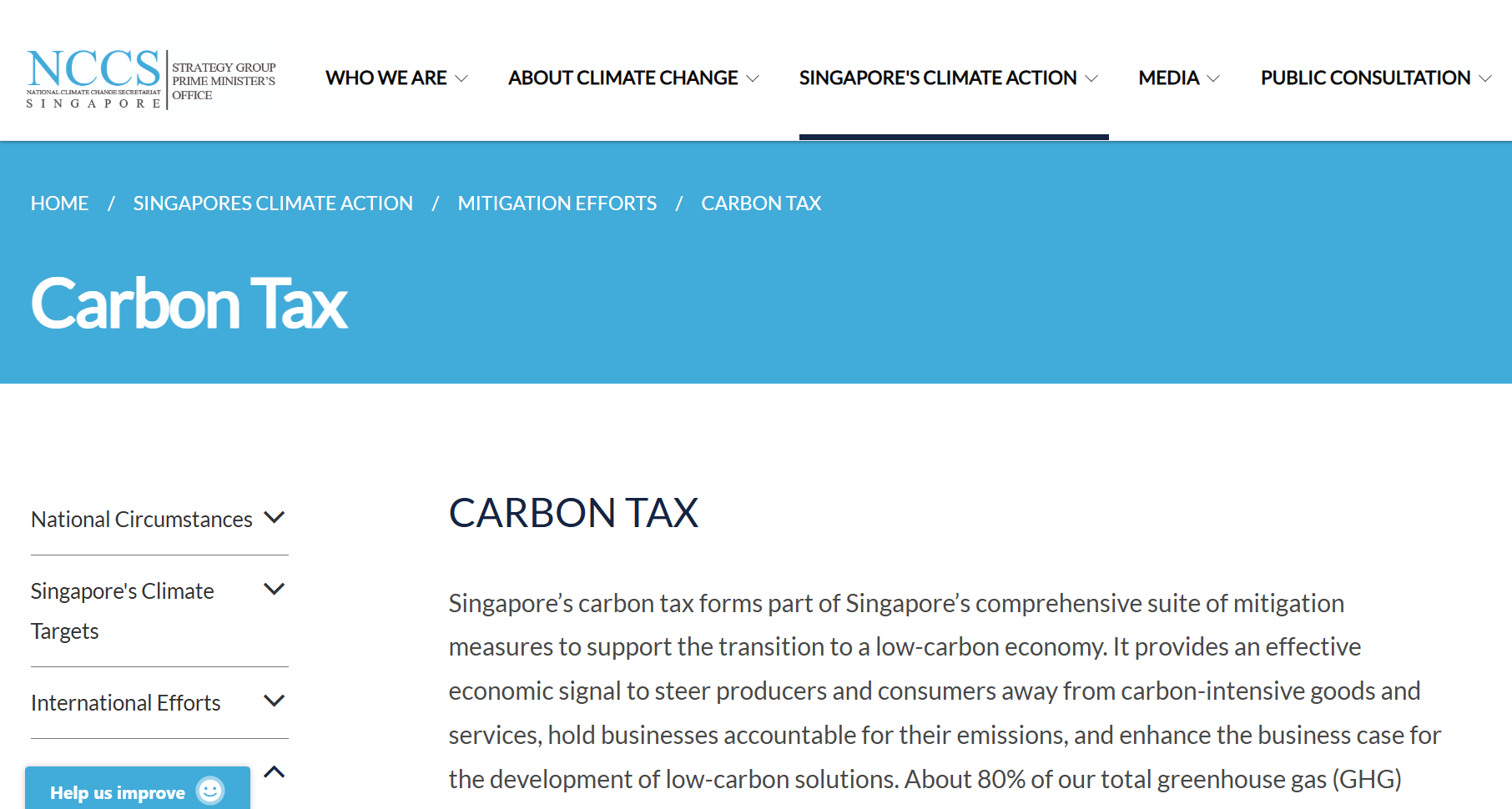
Singapore was the first country in Southeast Asia to implement a direct carbon tax. That matters more than most people realize.
The tax started at S$5/tonne from 2019 to 2023. It jumped to S$25/tonne in 2024 and 2025. It will hit S$45/tonne in 2026–2027. The target: S$50–80/tonne by 2030.
The tax currently covers 80% of Singapore’s total greenhouse gas emissions — roughly 50 facilities across manufacturing, power, waste, and water.
That trajectory creates a predictable, escalating compliance market. Companies operating in Singapore have a strong financial incentive to decarbonize — or to buy carbon credits.
From 2024, Singapore has allowed carbon tax-liable companies to use eligible international carbon credits (ICCs) to offset up to 5% of their taxable emissions.
Here’s why that’s significant: high-quality credits are currently available at under S$25/tonne. That’s below the current carbon tax rate. Companies that find and use eligible credits can reduce their tax bill while simultaneously funding real decarbonization projects in partner countries.
For carbon services firms, this is a direct commercial opening. Singapore’s National Environment Agency maintains an Eligibility List specifying exactly what qualifies — credits must be additional, real, quantified and verified, permanent, and free from leakage or double counting.
Pro tip: Familiarize yourself with Singapore’s Eligibility Criteria before sourcing credits for compliance use. The requirements align with Article 6 of the Paris Agreement — credits must have been generated between 1 January 2021 and 31 December 2030.
Carbon credits are only part of the story.
The Singapore Exchange now requires sustainability reporting from listed companies, aligned with the Task Force on Climate-related Financial Disclosures (TCFD). That creates demand for a different category of carbon services: measurement, accounting, strategy, and advisory.
Companies don’t just need to buy credits. They need to measure their footprint, set a credible low-carbon strategy, and report it publicly. That’s a multi-layer service opportunity.
One of the things that separates Singapore from other regional hubs is the depth of its government-level carbon market diplomacy.
Singapore has signed MOUs on carbon credits collaboration, aligned to Article 6 of the Paris Agreement, with Colombia, Indonesia, Morocco, Peru, and Vietnam.
These aren’t symbolic. They’re frameworks for legally binding Implementation Agreements that enable the international transfer of correspondingly adjusted mitigation outcomes (ITMOs).
Singapore has already substantively concluded Implementation Agreement negotiations with Ghana and Vietnam, and signed one with Papua New Guinea.
What this means for carbon services firms: Singapore is actively creating compliant credit pipelines with some of the world’s most carbon-rich countries. If you’re a project developer with capabilities in any of these markets, Singapore’s government is actively looking for you.
Beyond bilateral deals, Singapore has:
Here’s the short answer: Singapore is Asia’s largest commodity trading hub, and carbon is just the next commodity.
The city is home to around 400 trading companies. That base includes energy traders who are natural clients for carbon services firms. The existing trading infrastructure: price reporting agencies, financial intermediaries, legal frameworks translates directly to carbon.
A few specifics that matter:
Climate Impact X (CIX), Singapore’s dedicated carbon credit exchange and marketplace, has built its ecosystem from this foundation. CIX partnered with Nasdaq Technology to power its exchange infrastructure. Its partner network spans academia, carbon footprinting firms, project suppliers, and financial institutions.
Location gives Singapore-based firms something no amount of capital can easily replicate: proximity.
The vast majority of financially viable forest carbon sites are in APAC. SEA alone accounts for 20–25% of global NbS supply — over 5 million hectares of mangrove forests and seagrass meadows, plus the world’s largest stock of blue carbon.
Two examples show what operating from Singapore actually looks like in practice:
Shell runs the Katingan Mentaya Project in Indonesia from Singapore. That project covers 149,800 hectares of intact peat swamp forest and generates 7.8 million carbon credits annually — one of the largest REDD+ projects in the world.
Rize, a Singapore-headquartered joint venture between Breakthrough Energy, Temasek, GenZero, and Wavemaker Impact, is decarbonising rice cultivation across Vietnam and Indonesia. Over 2,000 hectares of rice farms. Working directly with smallholder farmers.
Both companies chose Singapore not for what’s inside its borders — but for what’s accessible from them.
Carbon markets need specialists. Singapore is building them deliberately.
In 2023, Singapore established the Green Skills Committee (GSC) — a joint effort between government, industry, training providers, unions, and trade associations — specifically to develop skills programmes for the low-carbon economy.
At the university level:
For mid-career and senior hires, Singapore has built specific pathways: the Sustainability Career Conversion Programme (CCP) for reskilling, the Capability Transfer Programme (CTP) for cross-border training, and the Leadership Development Initiative for Carbon (LDI) for early-career professionals.
For international talent specifically: carbon-related roles — including carbon trader, carbon project manager, and carbon verification specialist — appear on Singapore’s Shortage Occupation List. EP applicants in these roles can earn up to 20 bonus COMPASS points, improving their chances of approval.
If you want to hire carbon talent in Asia, Singapore is where the pipeline is being built.
Carbon credits are only as valuable as the methodologies behind them.
This is one of the biggest structural challenges in SEA’s NbS market: the lack of robust carbon accounting frameworks tailored to the region’s unique ecosystems — mangroves, peatlands, seagrass meadows. High MRV costs compound the problem.
Singapore is funding solutions at scale.
The National Parks Board is running a S$25 million Marine Climate Change Science programme to advance blue carbon science across Singapore and the region.
At COP27, the NUS Centre for Nature-based Climate Solutions (CNCS) launched “Carbon Integrity SG” — a S$15 million, five-year project developing high-fidelity carbon accounting methodologies specific to SEA ecosystems.
At COP28, NUS and ST Engineering Geo-Insights launched a S$1 million Decision Theatre — a scenario-modelling facility that lets project stakeholders identify sites across SEA, view satellite data on carbon-rich forest areas, and calculate economic returns on the spot.
The SCeNe Coalition (backed by TNC, WWF-Singapore, Wildlife Conservation Society, and Mandai Nature) also launched a tool to quantify conservation benefits from carbon projects — including deforestation risk forecasting.
Singapore has turned its constraints — small land area, no cheap renewables, no vast natural forests — into a strategic asset.
They’re doing it by becoming the connective tissue between where carbon credits are generated (SEA’s forests, peatlands, and farms) and where the capital and expertise to develop them lives (Singapore’s financial and trading ecosystem).
The city doesn’t need to be carbon-rich to become the center of the carbon economy. It just needs to be where the deals get done.
You don’t need to overhaul your Asia strategy overnight.
Start small:
For a deeper dive into Singapore’s trading infrastructure and carbon market policy, the EDB’s guide on carbon services and trading in Singapore is the primary reference.
If your company needs help filing taxes for the year 2026 or requires assistance with Singapore incorporation, economy, banking, etc., feel free to call /WhatsApp us at +65 90612851 or email us at aceglobalacct@gmail.com. Alternatively, you may leave us a reply using our contact form below.
Keep in touch to receive the latest listing, news updates and special offers delivered directly to your inbox.